

Historically, investing in real estate has always gone down as one of the most dependable methods to amass wealth, earn passive income, and secure one’s financial position. Compared to several other forms of investments, real estate presents a unique feature of delivering steady cash flow along with long-term property value increase. Yet, becoming a proficient investor hinges on meticulous plan…
Whether you have just made your mind to invest in real estate or you want to grow your property inventory, learning the fundamental principles of real estate investing can greatly boost your likelihood of winning. This book will take you through fundamental real estate investing tips that can support you in making wise decisions and gaining the highest profit possible.
Why Real Estate Investing?

Investing in real estate continues to be the top investment choice because it is associated with a number of benefits which include:
- Possibility of substantial property value increase over time
- Opportunity to earn regular income via rentals
- Diversification of investment portfolio
- Location-specific tax incentives
- Hedge against inflation
- Direct ownership of physical assets
While the benefits of investing in real estate are significant, there are also risks involved. That is why investors should always make decisions based on a well-defined plan and extensive research.

1. Determine Your Investment Objectives
You should only focus on purchasing a property after outlining your investment goals up front. If you want one thing, you will have to pursue a totally different plan than if you want something else…
Consider whether:
- earning rental income on a monthly basis is among your pe…
- long term capital appreciation is what you desire
- property flipping/renovating is your interest
- retirement investing is your plan
- generational wealth is what you want
By having definite goals, you will limit the type of properties that you are looking for and at the same time, determine the investment approach most suitable for you most of all.
2. Investigate the Market Thoroughly
Successful real estate investing begins with understanding the local market.
Key factors to evaluate include:
Population Growth
Areas that show rapid population growth usually have increased housing demand, which can cause property prices and rental rates to go up.
Employment Opportunities
People want to live where there is work, so good labor markets create continuing housing demand.
Infrastructure Development
Over time, property values can be greatly enhanced through construction of new highways, public transit, schools, and commercial centers.
Rental Demand
One should check vacancy rates alongside average rents to see if a property is capable of producing stable income.
Top investors dedicate a lot of time to market research prior to purchasing a property.
3. Prepare a Practical Budget
Many new investors fail to precisely estimate investment costs. Most often, newbie investors become victims of inaccurate cost estimation for investments.
Your budget must fully include:
- Your Down Payment
- Closing Costs
- Annual Property Tax
- Home Insurance
- Maintenance Expenses
- Renovation Costs
- Property Management
- Setting Aside for Emergencies
Having a detailed financial strategy at your disposal, you can face a challenge of planned and unexpected expenses, both.
4. Prioritize Positive Cash Flow
In fact, cash flow is the very essence of real estate investing.
It is positive cash flow when the total rental income not only supports but also exceeds the operating costs, mortgage included.
Example:
Monthly Rent: $1,500
Expenses:
- Mortgage: $900
- Insurance: $100
- Taxes: $150
- Maintenance Reserve: $100
Total Expenses: $1,250
Positive Cash Flow: $250 per month
A strong positive cash flow from real estate investments provides owners with financial stability and reduces exposure to risks.
5. Decide Which Property Type is the Best Fit
Briefly, different types of properties come with their own pros and cons.
Single-Family Homes
Very well-liked by small and first-time investors due to the lower initial purchase price and simple nature of operating these properties.
Multi-Family Properties
Provide you with the ability to collect rent from more than one tenant and thus can enhance your cash flow significantly.
Commercial Properties
At times, they can yield you much larger incomes, but require that you have a deep understanding of the business, and probably a larger sum to invest.
Vacation Rentals
Could deliver very strong returns in locations popular with tourists but may be subject to seasonal lows.
Pick a property style that will be in line with your objectives, resources, and ability to manage.
6. Do Not Skip Property Inspections
They can point out hidden defects which are not visible to the naked eye.
Various things are checked by the inspectors such as:
- Load bearing walls
- Status of the roof
- Water pipes
- Electrical wiring
- Heating and air conditioning systems
- Ground/foundation
By doing an inspection, which does not cost much, you may avoid many a headache later.
7. Focus on Location
So much so, that property agents usually iterate location as the most crucial factor in real estate investing.
Besides investing in properties situated in a vibrant neighborhood, you could also consider:
- Business centers and office parks
- Schools and colleges
- Hospitals
- Shopping areas
- Transportation hubs
- Leisure venues
A place in a good and desirable location usually draws in high-quality tenants and is inclined to appreciate in value steadily over time.
8.Build an Emergency Fund
No matter how well run a real estate investment property is, the possibility of unforeseen expenses cannot be suppressed.
Here are a few:
- Unauthorised leak damage repair
- The cost of cabinets or other major appliance replacement
- Being-paid vacation periods
- Emergencies where property is damaged
The pros in this field normally have their emergency reserves at least three to six months of the property expenses.
Having a reserve fund that is large enough will let your investment breathe even during tough times.
9. Understand Financing Options
It is a matter of great significance how you finance a real estate deal as this may be an important factor that influences your returns.
Some of the options that you have are:
Standard Mortgage
Loans that a bank or other financial institution offers to an individual to help them buy property.
Loans for Income-producing Property
These are usually tailored to the needs of investors who carry rental operations.
Private Investor
Obtaining a loan from an individual investor instead of going to the bank.
Owner Financing
This is a mechanism in which the seller is the one providing the funds for the purchase of his or her property.
Analyze the loan agreement, APR, and payback plan before finalization.
10. Screen Tenants Carefully
Your returns largely depend on your tenants.
These are the elements of a good tenant screening:
- Is their declared income genuine?
- Are they employed?
- Have they been thoroughly
- Are their references speaking truth?
- Are they mentally sound?
Good tenants are inclined to timely payment of rent and good property upkeep.
Typical Real Estate Investing Mistakes to Avoid
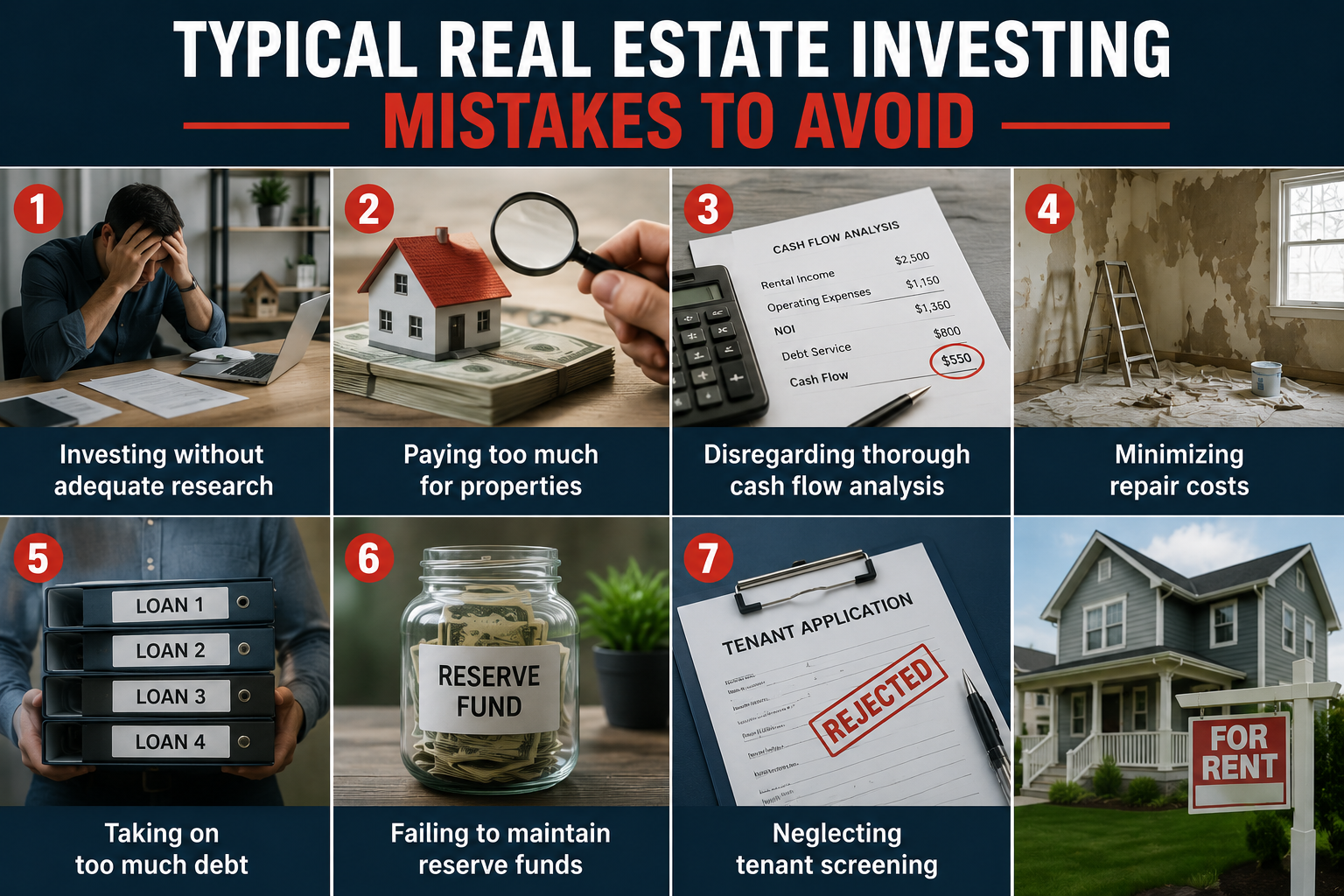
If you keep away from certain common mistakes, you can drastically improve the way your investments turn out.
Some of the most frequent errors include:
- Investing without adequate research
- Paying too much for properties
- Disregarding thorough cash flow analysis
- Minimizing repair costs
- Taking on too much debt
- Failing to maintain reserve funds
- Neglecting tenant screening
Having these mistakes pointed out to you can be a great help as it will not only save you money but also time.
Investing in real estate is capable of turning your life around by providing you with a lot of wealth generation and financial independence. With that in mind, those who successfully go down this path are those who plan thoroughly, carry out detailed market research, and have a solid financial management strategy in place. They invest in their knowledge and acquisition of new skills.
Setting objectives, finding areas that will yield positive cash flow, locating a good neighborhood, and risk management along the way are only a few of the means through which investors build a real estate portfolio that through the years brings high returns. No matter whether you are dealing with your first property for rent or you have a big one already, following these well stored real estate investing tips will enable you to build up your investment skills and lead to sound investment choices and sustainable financial growth.
FAQ’S
1. Why should we choose an investment in real estate?
It’s called a no-brainer when you talk about real estate as being a secure option to invest because the value of the property will likely appreciate, thereby and alongside the regular rental income, diversification of the portfolio, tax incentives, and hedge to inflation, expect increasing rental rates.
2. What are the first steps to successful real estate investing?
Start by crystalizing your investment goals. Whether you’re in the rental income, property dealing, or long-term capital appreciation business, it is important to first set your investment targets.
3. How can I ensure positive cash flow from my investment?
The positive cash flow is when the rent is greater than the mortgage and maintenance fees. To keep your financial status backed up, be sure to meticulously calculate and review your monthly expenses.
4. What types of properties should I consider?
You can consider the single-family units to rent, multi-family to invest in for the rental business, commercial properties to rent out, or vacation rentals as your options considering your goals, resources, and the time you invest in property management.
5. Why is location important in real estate investing?
There is no denying the fact that location is the biggest determinant of property value appreciations and tenant quality. Properties adjacent to lively neighborhoods and amenities such as schools and business are more likely to perform well.
Related Post: