
In the contemporary working world, a vast majority of people have to work in front of a PC in the office for quite a long time. This sitting-around-every-day lifestyle would make them feel uncomfortable, lead to poor posture, back pain, and even cause their productivity to drop. That is why ergonomic office furniture has taken the market by storm lately and one of the best-selling products is the riser desk.
What is a riser desk then and why are so many people at work investing in it? This is the question we are going to answer in this article! Firstly, we will introduce what a riser desk is. After that, we will talk about its benefits, types, features, and some tips for choosing the best riser desk for your office will be shared with you.
What Is a Riser Desk?
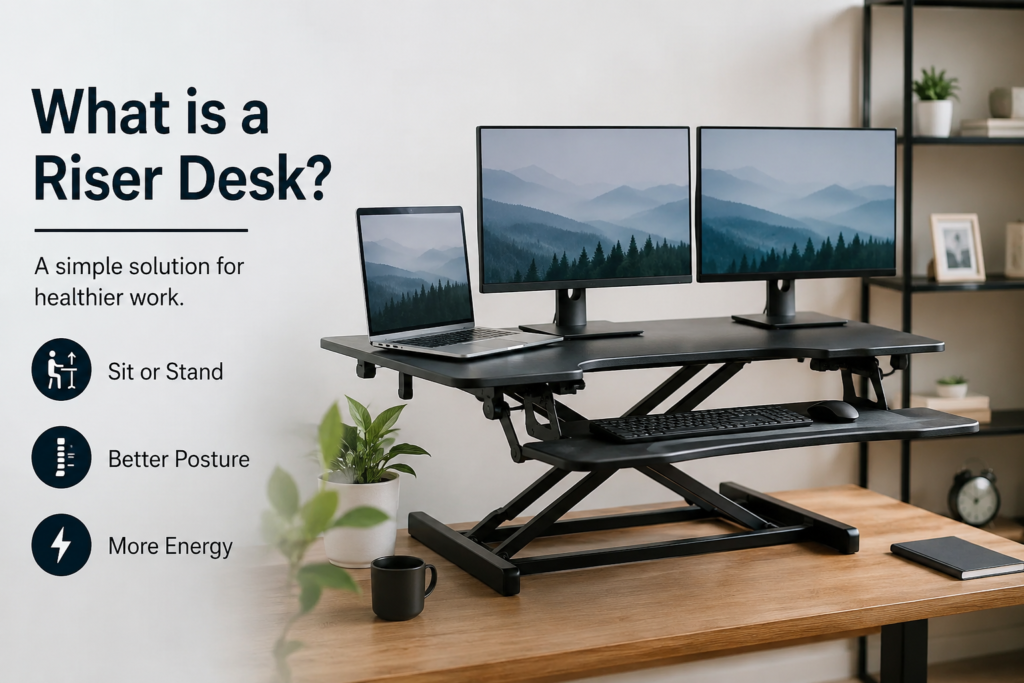
A riser desk (riser is also referred to as a desk riser or standing desk converter)
Being a simple desk accessory only, a riser desk is actually an adjustable platform that can be put on top of a conventional desk. It gives the user the opportunity to elevate their computer, monitor, keyboard, and other items to a height suitable for working while standing.
In contrast to a standing desk that totally substitutes your old set-up, a riser desk will change your usual desk to an area where you can either sit or stand to work. Switching between sitting and standing performing the day’s work without changing furniture, riser desk users are quite mobile.
Essentially, a riser desk is used to promote physical activity and enhance ergonomics at work thereby helping people to maintain a good posture more easily and possibly even eliminate the health risks that are linked to sitting for a long time.
How Does a Riser Desk Work?
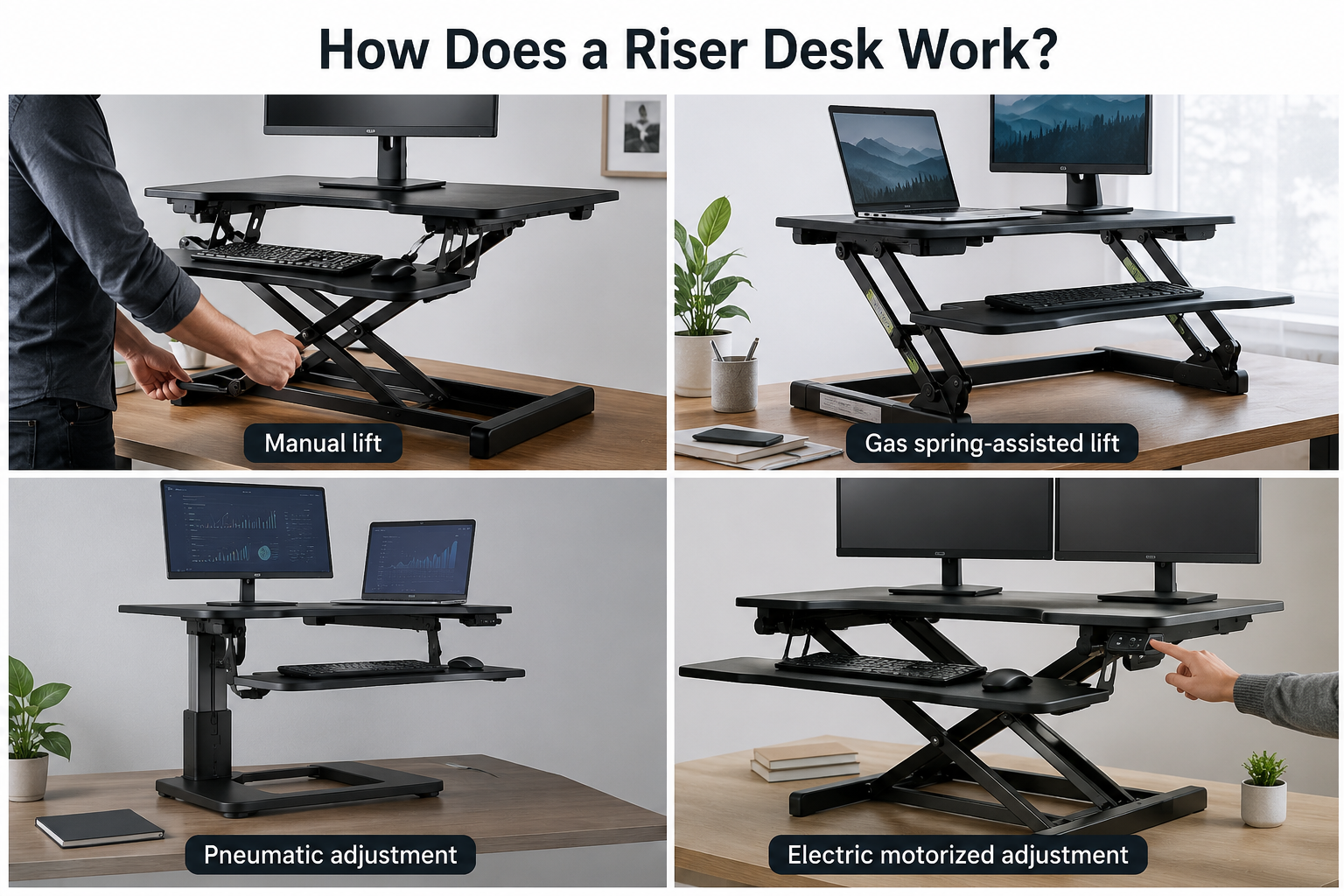
In order to enable the riser to be lifted and lowered quite effortlessly, there is a raise/lower mechanism built into the riser desk.
There are different types of mechanisms. For instance:
- Manual lift
- Gas spring-assisted lift
- Pneumatic adjustment
- Electric motorized adjustment
Riser desks are designed in such a way that the user can operate the height setting in a matter of seconds keeping it easy to change postures; sit or stand during the working hours.
Users then just want to adjust the height to the level that suits them best after they have put their monitor, keyboard, laptop, and other work accessories on the riser.
Benefits of Using a Riser Desk
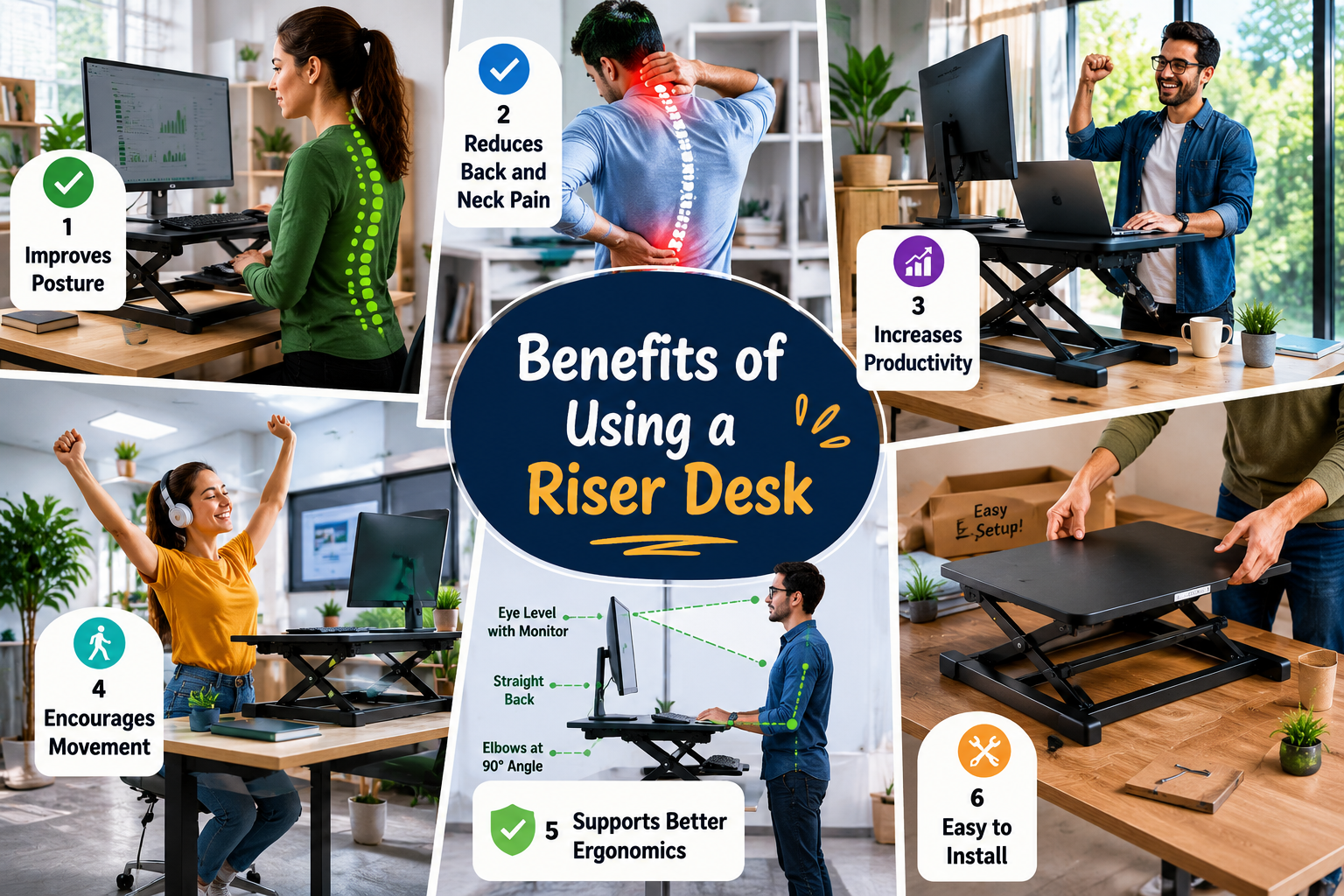
1. Improves Posture
Out of all the things that may cause such poor health in the office, poor posture is definitely one of the main culprits. This is because when you are sitting for so long, it becomes almost natural that your back hunches over the keyboard or the computer screen.
One of the main advantages of utilizing a riser desk is that it will help you to first place your screen at the eye level and secondly the whole structure of your body, neck, shoulders, and spine to be aligned in a natural manner.
2. Reduces Back and Neck Pain
According to research, the problem of back and neck pain due to the factor that one is sitting in the same position for a long time is very common. The spinal problems can be relieved by alternating between sitting and standing positions thus the muscle strain can be minimized.
You may be able to get rid of the pain and discomfort of the back that sometimes come without a warning in the office or during your work at home by only making use of the riser desk and ensuring that it is configured correctly.
3. Increases Productivity
Some studies have shown that standing intermittently throughout the day mightpotentially benefit the user in terms of concentration and energy. This is why a great number of users of riser desks have said that they felt much less tired and more engaged in their activities when they were able to change their position.
Using a riser desk can be one of the ways to prevent your body from becoming completely span out and keep your mind focused during long hours of work.
4. Encourages Movement
Desk jobs have been pinpointed as one of the main reasons leading to an unhealthy lifestyle due to inactivity. Pushing up and down the button making it very easy to change the posture and thus get the blood flowing, riser desks effectively encourage users to move more often.
Regular movement, besides keeping circulation at a healthy level, also goes a long way in preventing stiffness.
5. Supports Better Ergonomics
Having an ergonomic workstation plays an important role in our comfort and especially the health of our muscles and joints in the long run. Riser desks give you the liberty to set your work environment as per your height and preferences.
Such an impossibly flexible feature is what helps to turn a not-so-healthy and uncomfortable workstation into one that benefits your health and comfort in all respects.
6. Easy to Install
Desk risers, unlike the full-standing desks, are typically very easy to install. Most of them come preassembled, and some others may even require only the simple tightening of a couple of screws.
Just plop it onto the top of your current desk and you can immediately begin to use it!
Types of Riser Desks
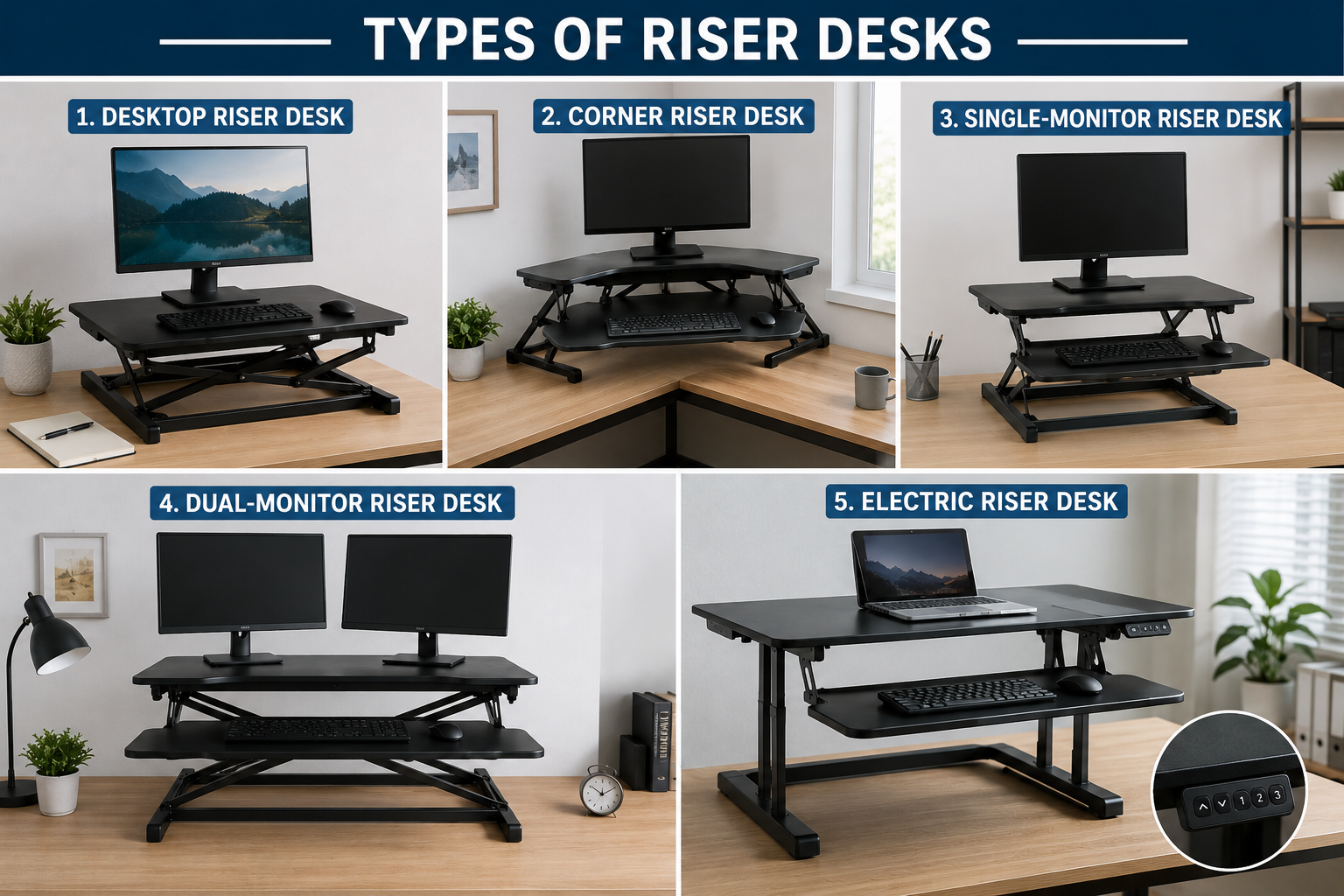
Desktop Riser Desk
You can say that this one is the standard one. It’s simply placed on top of your already-existing desk and elevates your outfit and tools to the height suitable for standing.
Great for some: Personal offices, home, and small rooms.
Corner Riser Desk
Greatly tailored to the working environment of corner desks, these kinds of risers are designed to provide the maximum output from the limited space whilst still maintain a user-friendly and ergonomic design.
Great for: Corner office settings.
Single-Monitor Riser Desk
Smaller risers are suitable for users who only have a single monitor or a laptop.
Great for: Very limited and minimal work space situations.
Dual-Monitor Riser Desk
These downsized risers have LED displays of two, filled with keyboard and mouse or other user accessories like pen holders, watches, etc.
Great for: Programmers, designers, and multitasking professionals.
Electric Riser Desk
This type is more advanced and allows users to adjust the height with just a button-touch.
Great for: Convenience seekers and those who adjust their desk positions quite frequently.
Who Should Use a Riser Desk?
The list of potential riser desk users is quite long:
- Those working in a traditional office
- Someone working remotely
- Freelancers
- Students
- Programmers
- Graphic designers
- Content creators
- Customer support staff
- Business owners
To be frank, all those who use a computer for 4 or more hours per day can benefit from a riser desk.
Key Features to Look for in a Riser Desk
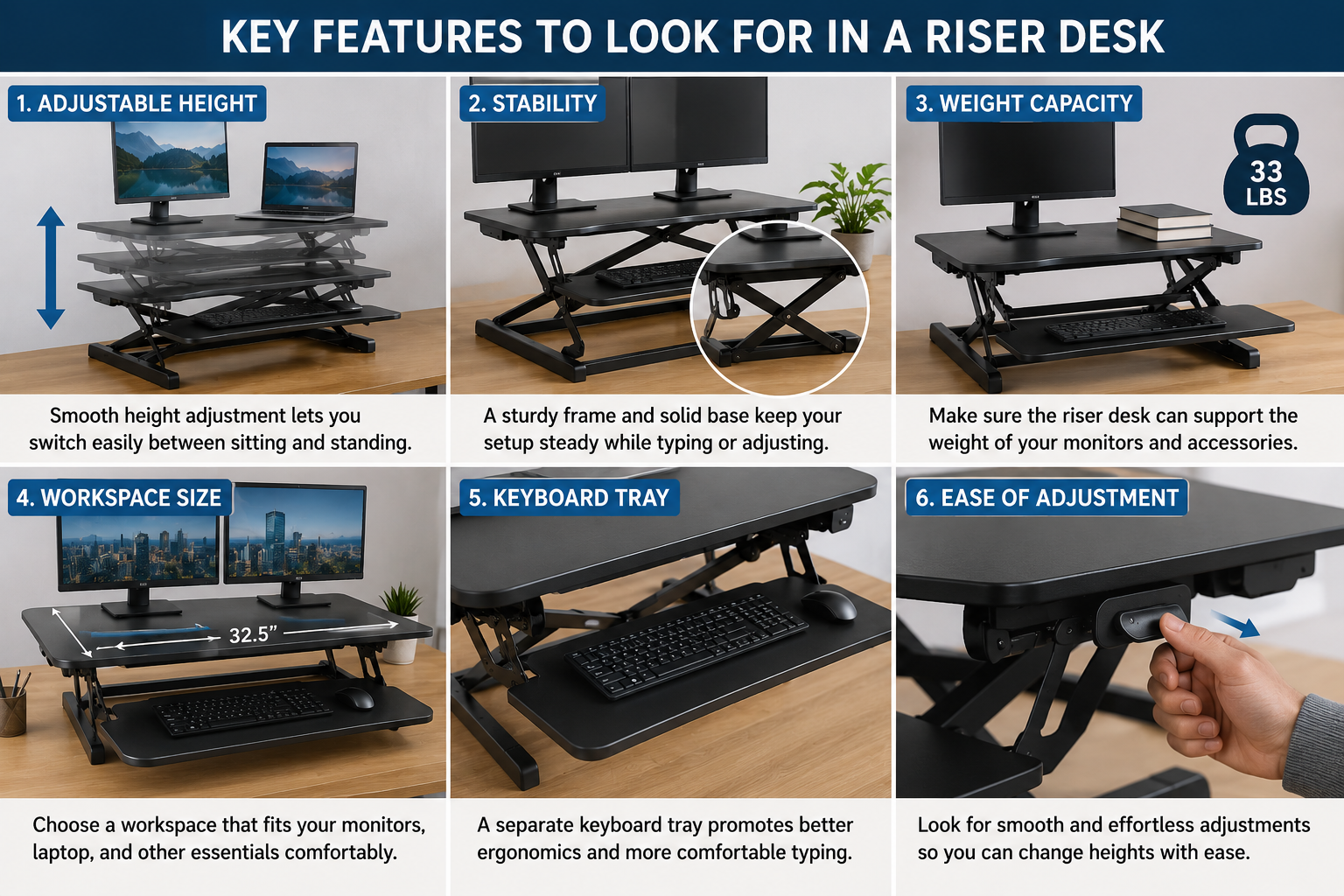
Adjustable Height
Get a riser desk that is able to handle a wide height range so that you can both enjoy the sitting and the standing positions without getting any discomfort in the process.
Stability
Find one with a very solid base so that there is almost no shaking that happens when you are typing and stretching your hands.
Weight Capacity
If you have a lot of gadgets, then make sure it can carry the heaviest one with ease, and maybe a couple more ones.
Workspace Size
Think of what all of your gadgets and equipment besides your monitor and keyboard are and decide how much surface space you need to take care of them comfortably.
Keyboard Tray
You can find a keyboard tray distinctly separated from the rest of your desk, and if you want to be super ergonomic, you should also consider it.
Ease of Adjustment
One of the very minor reasons people do not make use of the standing options of their risers is if the height change mechanism is hard to operate.
Riser Desk vs Standing Desk
|
Feature |
Riser Desk | Standing Desk |
|
Cost |
Cheaper |
More expensive |
|
Installation |
Requires little to no setup effort | May require assembly and installation |
|
Existing Desk Needed |
Yes, it sits on top of an existing desk | No, it replaces your current desk |
| Portability | Lightweight and easy to move |
Less portable due to larger size and weight |
|
Workspace Size |
Limited working surface | Larger and more spacious work area |
|
Adjustment Options |
Good height adjustment options |
More advanced and wider adjustment range |
| Best For | Budget-conscious users who want a sit-stand setup |
Users seeking a permanent ergonomic workstation |
|
Space Requirement |
Takes up minimal office space | Requires dedicated floor space |
|
Flexibility |
Can be used on different desks | Fixed workstation setup |
|
Long-Term Investment |
Affordable short-term solution | Better long-term ergonomic investment |
Those who want to get a standing desk experience without completely getting rid of their current workstations can use a riser desk as a quite reasonable alternative.
Tips for Using a Riser Desk Effectively
Here are some tips to make the best use of your riser desk:
- Change positions by sitting or standing every 30 to 60 minutes.
- Your monitor should always be at the eye level.
- Set your keyboard position in a way that your arms form a 90-degree angle at the elbows.
- Dress in footwear you like wearing when standing.
- For more comfort, you can use an anti-fatigue mat.
- Keep good posture all day long.
Do not think that standing for the whole day will be better than sitting all day. You need to make a compromise between the two.
Common Mistakes to Avoid
Standing Too Long
A stand-riser desk user might think that standing the whole day while working is a great idea. However, standing for too long can cause discomfort as well.
Incorrect Monitor Height
A monitor that is set too high or low will cause the user to strain the neck.
Poor Keyboard Position
Having a keyboard in an inconvenient place means wrists and shoulders will be under pressure and discomfort will result.
Ignoring Movement
Riser desks aside, formal stretching and walking breaks are musts for everyone.
Is a Riser Desk Worth It?
People struggle with sticking to the new lifestyle at work: to move, stretch, breathe and even just stand up.
Nevertheless, a riser desk is totally worth it for it contributes greatly to the promotion of a healthy lifestyle and habits at work. For one thing, ergonomic factors are taken into account better than with sitting; for another, it is very comfortable to alternate sitting and standing positions.
You can depict your workspace as one that you can enjoy and make the most out of every day when you work from home, office, or as a freelancer. At the end of the day, no matter where you set your feet, a riser desk is there to help you out.
A riser desk is an easy-to-modify ergonomic solution to turn a regular working desk into a sit-stand desk. Alternating between sitting and standing using a riser desk is linked to enhancing posture, minimizing pain and discomfort, ramping up productivity, and encouraging healthier work habits.
Besides, there are many different types of riser desks with different features. Typically, one can be found for any workspace and any budget. A riser desk is definitely worth considering if you want to have a better office setting and more comfort during your normal working hours.
FAQ’S
1. What is a riser desk?
A riser desk is one type of standing desk that can be placed on your current desk and made to do both standing and sitting work positions.
2. How does a riser desk work?
Reser desks feature a simple mechanical system that allows changing the level of the top part where the keyboard, monitor, and other necessary equipment is placed. In this way, you can heighten or lower the main working area of the desk and easily switch between comfortable sitting and standing positions.
3. Is a riser desk better than a standing desk?
Each has its own set of benefits. A riser desk typically costs less and can be used in combination with any existing desk as a riser, whereas a standing desk generally provides you with a bigger work surface as well as a wider range of heights for the adjustment.
4. Can a riser desk help with back pain?
In fact, a riser desk that is geared toward the right height can lead to better posture and consequently, a decrease of back, neck, and shoulder pain by means of a more ergonomic set-up.
5. Who should use a riser desk?
Generally, a riser desk will suit office workers, telecommuters, students, coders, artists, content makers, and practically anyone who stays working on the computer for extended periods of time.
Related Post: