
Fashion is not only about art and keeping up with the latest trends; more than anything, it’s about how one organizes and identifies products. Perhaps you are a clothing brand owner, retailer, designer, or maybe just a shopper. In any case, you have probably stumbled upon the phrase style number.
So, what is a style number, and why is it so essential in the fashion world? This article will explain what a style number is within the fashion industry. It will describe how it functions, the reasons why many fashion brands have adopted it, and in what situations it deviates from other product identification codes. Then, you will be pleased to have included this significant fashion terminology in your vocabulary.
What Is a Style Number in Fashion?
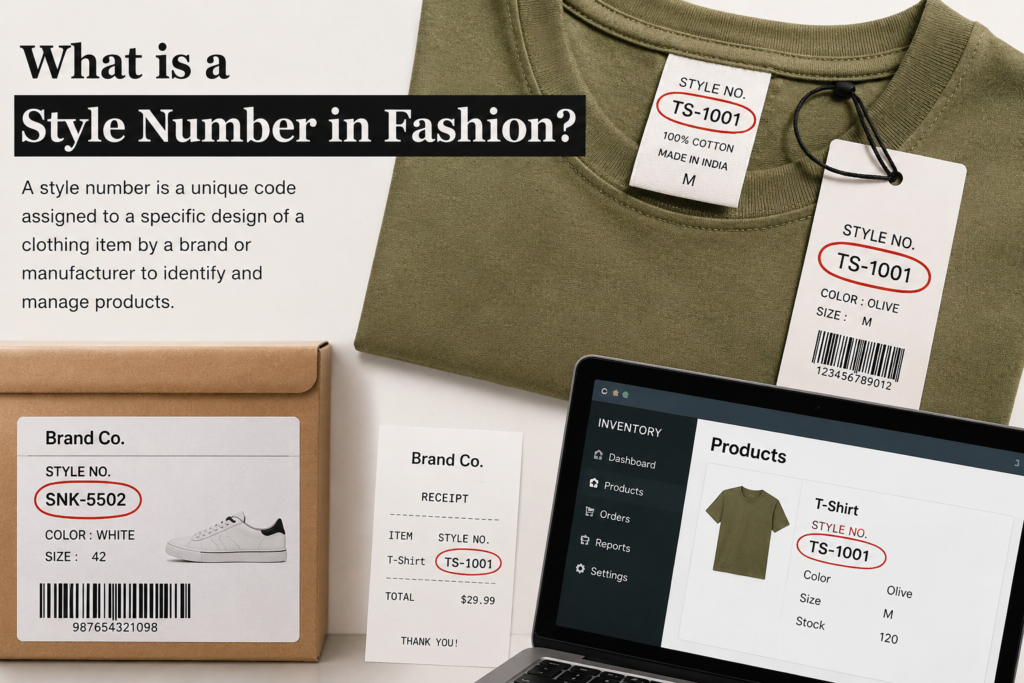
In essence, a style number is a code that a brand, or manufacturer gives to a particular clothing design, footwear style, or any other fashion product. As far as businesses go, they can use the style number to track, manage, identify products all the way through different stages of production, distribution, and retail.
We can think of the style number as a product’s one and only ‘face’ in the fashion brand’s catalog. Fashion companies might go for item names or style numbers – the latter being short, numerical, or alphanumeric codes.
Here are some examples:
- A Summer Dress With Floral Print for Women – Style No. DRS-1024
- Slim Fit Jeans Made of Denim for Men – Style No. JNS-5501
- Leather Ankle Boots – Style No. BT-889
These codes are of great help when it comes to the efficient management of stocks and the facilitation of communication between the manufacturers, suppliers, retailers, and customers.
Why Are Style Numbers Important?
A single-season collection of a fashion brand may include hundreds or even thousands of products. Such a scenario would make it extremely hard to manage the inventory without an identification method that is both systematic and effective.
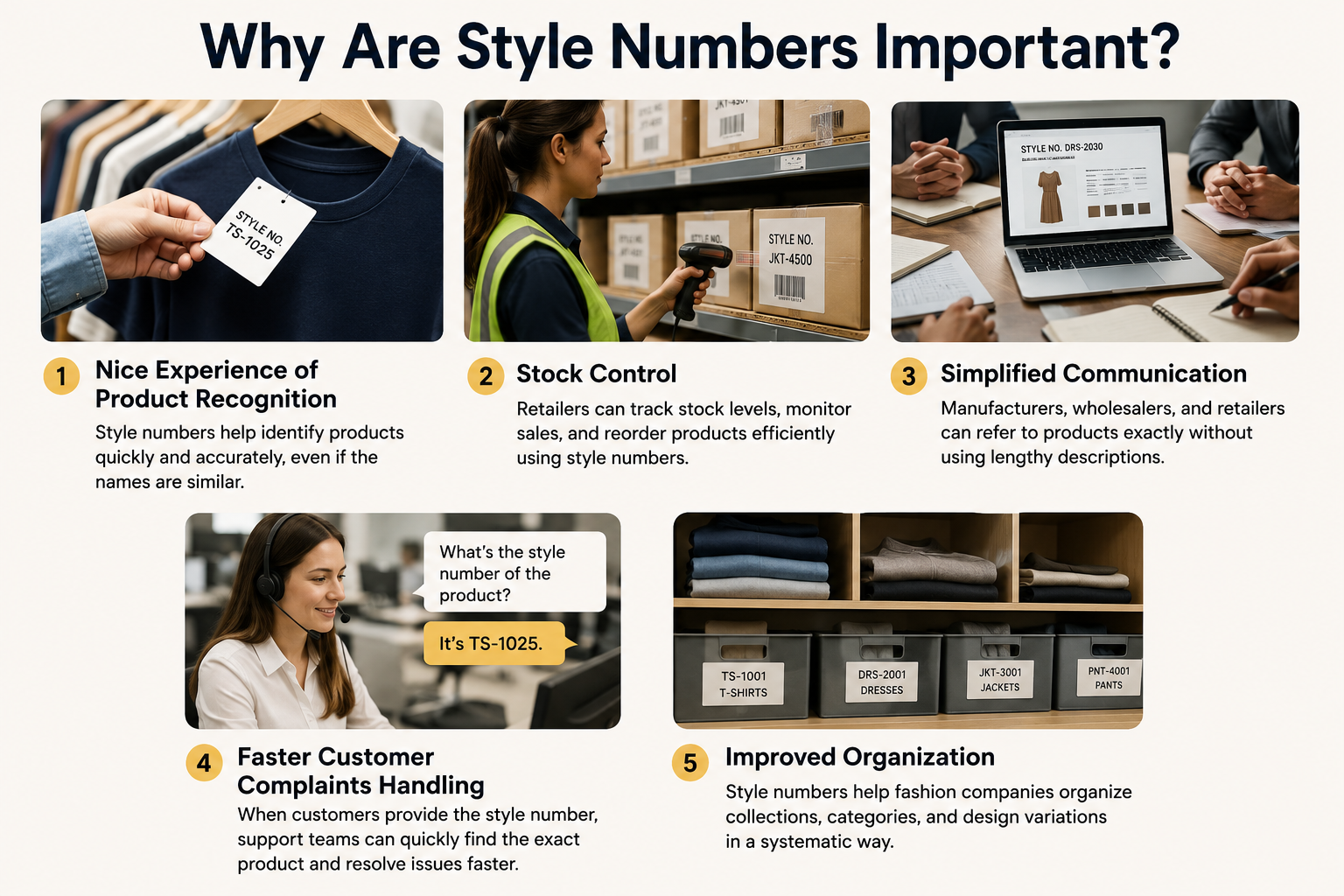
Here are the chief points that underline the importance of style numbers:
1. Nice Experience of Product Recognition
With the help of style numbers, brands and store owners are able to identify products quickly and with certainty. The style numbers differ even if the items have very similar names.
2. Stock Control
Retailers who use style numbers are able to monitor stock levels, evaluate the sales of the different products and also place orders for the products that are running out in a highly efficacious manner.
3. Simplified Communication
With the help of style numbers, manufacturers, wholesalers, and retailers can refer to a particular product quite exactly without relying on lengthy product descriptions.
4. Faster Customer Complaints Handling
When customers call support and give the style number, this enables the support team to quickly identify the exact product.
5. Improved Organization
Fashion companies use style numbers as a way to keep their seasonal collections, product categories, and design variations orderly.
How Does a Style Number Work?
The product development phase is the most common time for a style number to be issued. Each company has its very own numbering system.
In case you were wondering, this is an example:
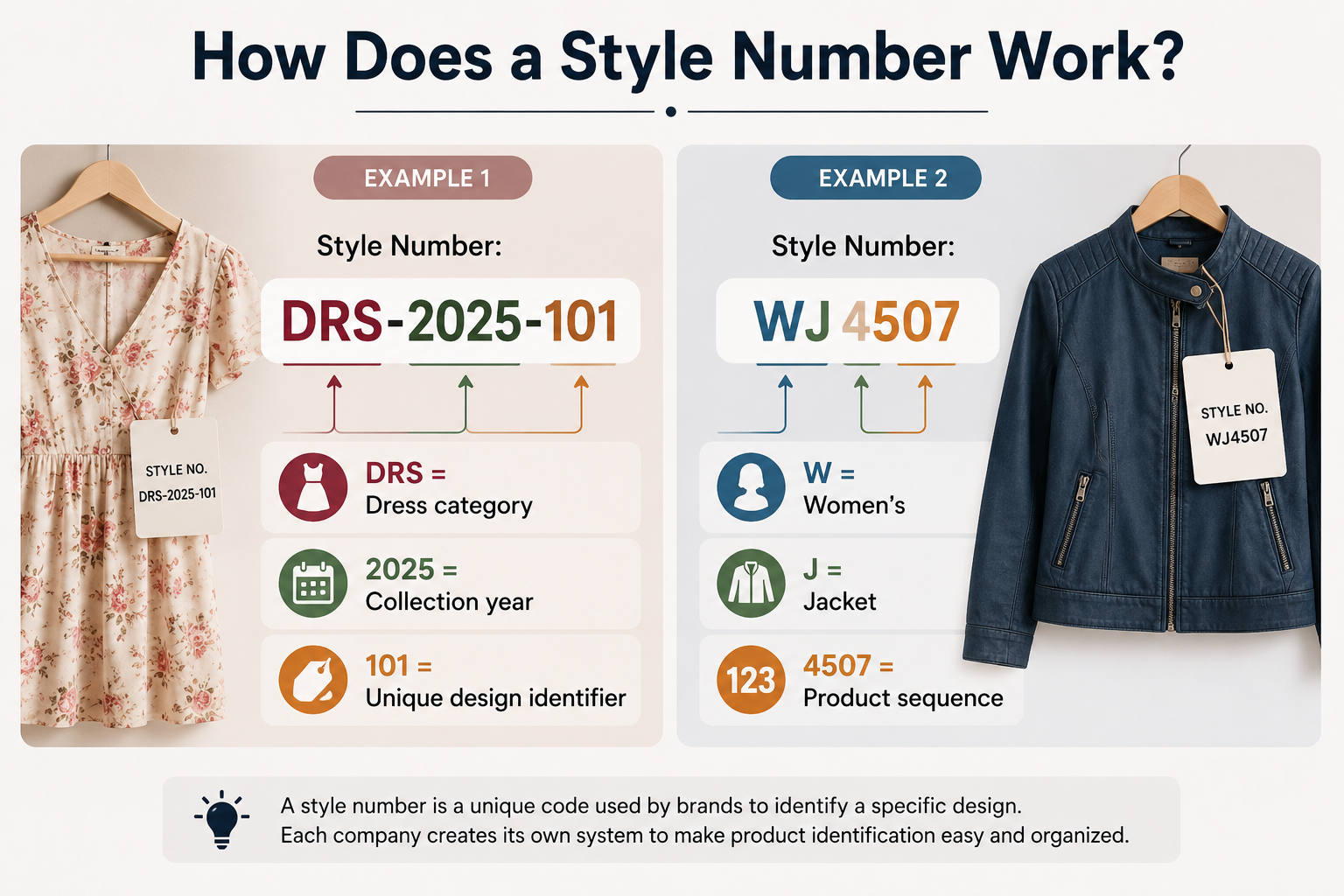
Style Number: DRS-2025-101
- DRS = Dress category
- 2025 = Collection year
- 101 = Unique design identifier
Another company could have a numbering system as follows:
Style Number: WJ4507
- W = Women’s
- J = Jacket
- 4507 = Product sequence
On the whole, there does not exist the one universal format. A brand creates a system that is in line with its inventory and product management requisites.
Where Can I Find a Style Number?
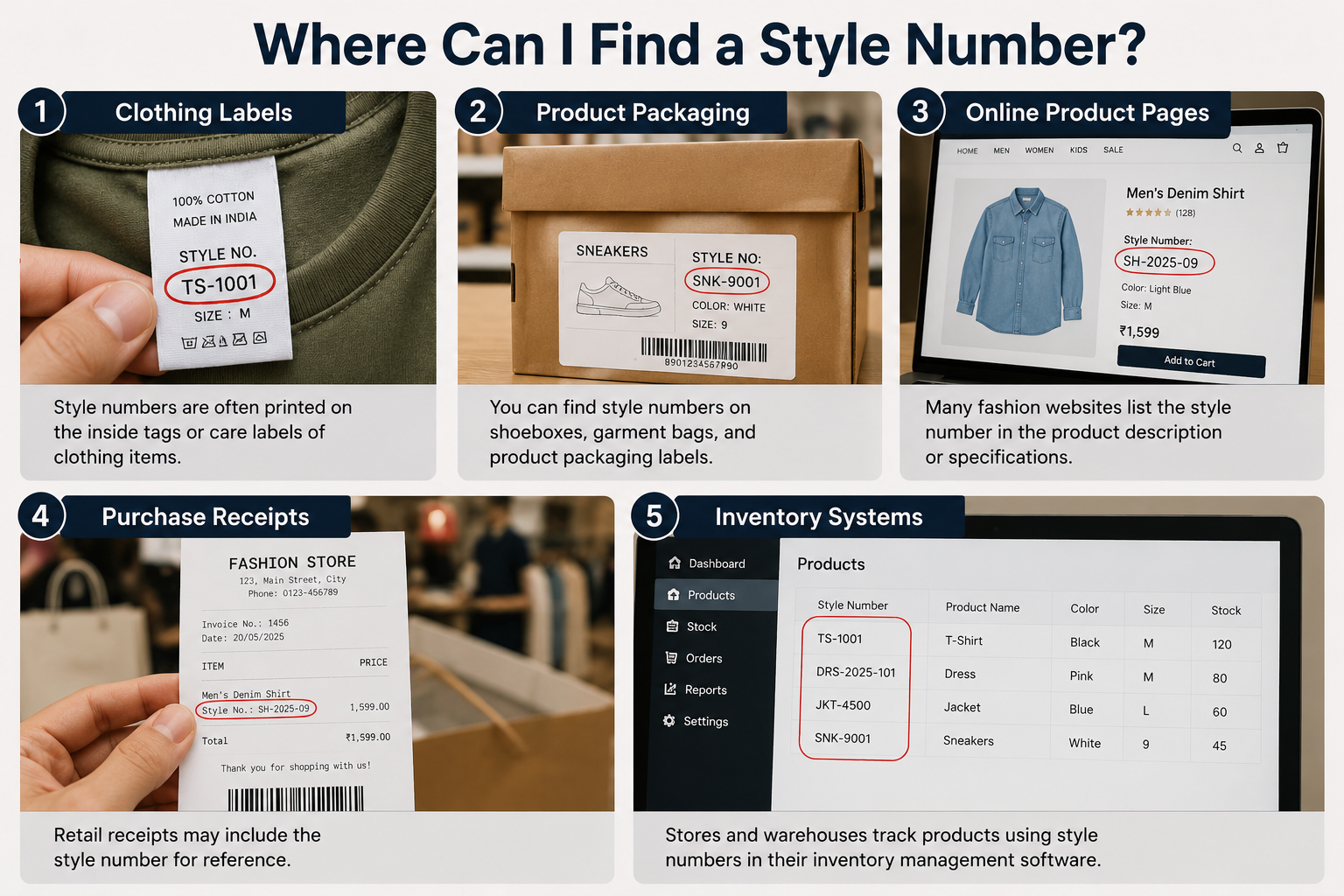
Style number can be located in these typical spots among others:
Clothing Labels
A style number could be one of the elements printed on the inside garment tag or on the care labels of clothes.
Product Packaging
The style number usually appears on shoeboxes, garment bags, and labeling of the packages.
Online Product Pages
Style numbers are often provided by fashion websites in the product description or specification sections.
Purchase Receipts
There’s a possibility that the style number will be on the retail receipt as a reference.
Inventory Systems
Stores and warehouses keep track of products using style numbers through their inventory software.
Style Number vs SKU: What Are the Differences?
Many times people mistake style numbers with SKUs (Stock Keeping Units) whereas they imply two different things.
|
Style Number |
SKU |
|
Specifies the design of the product. |
Identifies a particular inventory item. |
|
Assigned by the brand or manufacturer. |
Assigned by the retailer or inventory/inventory-management system. |
| Usually changes rarely. |
Can vary between retailers or systems. |
| Represents the overall design or style. |
Represents a specific variation (size, color, fit, etc.). |
| One style number can cover multiple versions of the same design. |
Each size/color combination typically has its own SKU. |
Example
There could be different versions of a black T-shirt design:
- Style Number: TS-1001
But there will be different SKUs:
- TS-1001-BLK-S
- TS-1001-BLK-M
- TS-1001-BLK-L
The style number shows the design, and the SKUs show different variations of the same design.
What Is a Style Number Compared to a Model Number?
Mixing up style numbers with model numbers is another frequent mistake.
As far as fashion goes, the meaning of the two words is almost the same, especially if we are talking about shoes, handbags, and accessories. Yet:
- Style Number is about the design identity.
- Model Number may refer to the general product classification.
Depending on their own working systems, various brands may call things differently.
Examples of Style Numbers in Fashion
Fashion is a world where different brands breathe their own life into style numbers.
Apparel
- DRS-1001
- TOP-2205
- JKT-4500
Footwear
- SNK-9001
- RUN-5505
- BT-7700
Accessories
- BAG-1501
- HAT-2202
- BELT-3301
These are just sample style numbers and show the abbreviation that is usually a code for product category.
How Fashion Brands Develop Style Numbers
Typically, brands build style numbers via some sort of a system.
There are a few basic components:
Product Category
Examples:
- DRS = Dress
- TOP = Top
- JKT = Jacket
Collection Season
Examples:
- SS25 = Spring/Summer 2025
- FW25 = Fall/Winter 2025
Design Sequence
The assigned serial number of a design.
For instance:
SS25-DRS-102
This sequence of characters likely identifies the 102nd dress design in the Spring/Summer 2025 line.
How Style Numbers Aid Fashion Firms
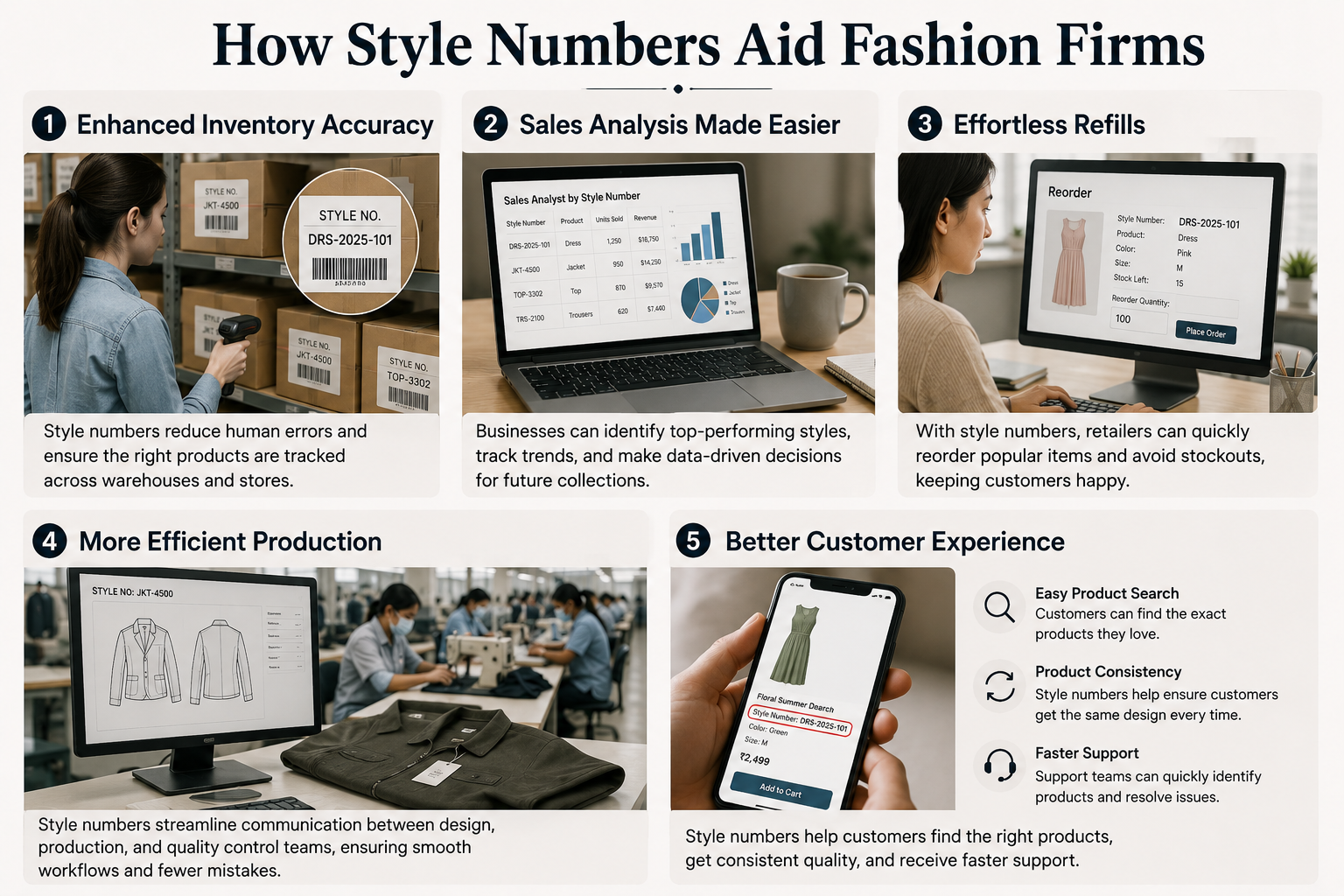
Enhanced Inventory Accuracy
Assigning style numbers to products make it possible to monitor them more accurately in storage locations and retail points.
Sales Analysis Made Easier
Style numbers enable a fashion company to see which products are performing best in the market.
Effortless Refills
If a particular product turns out to be a hit, fashion businesses can very quickly place a new order for it.
More Efficient Production
During the manufacturing and quality control processes, style numbers can be very handy references.
Better Customer Experience
Using a style number, customers are likely to find the products they want more quickly.
How Customers Can Utilize Style Numbers
Style numbers can land you a great deal and help you make the right purchase decision. These alphanumeric characters can do a lot for customers apart from identifying products.
Search the Same Product
It might happen that you liked a particular item, but the store where you saw it does not have it in stock. Then all you have to do is to enter the style number of that item in the search engine and you might be lucky to find it in other stores.
Authenticate by Style Numbers
One of the ways to authenticate a product is to verify the style number. If it corresponds to the number the brand is using, then it is highly likely that the item is genuine.
Style Number for Price Comparison
Via online platforms, users can easily look up style numbers and get information on different retailers who stock the items in question, enabling them to find the best price.
Style Number for Designing
If a design appeals to you and you wish to get the same one, the style number is definitely of help because it is the most unique identifier in a store.
Examples of Industries Using Style Numbers
In fact, the industries using style numbers are:
- Clothing
- Footwear
- Handbags
- Jewelry
- Sportswear
- Luxury Fashion
- Uniforms
- Accessories
- Children’s Apparel
In most, if not all, areas of the fashion business, style numbers are used for organizing and controlling the inventory.
Style Number Problems
Despite being highly valuable, style numbers also have some limitations for the businesses:
Double Numbering
Improper numbering practices often lead to the generation of duplicate codes.
Tricky Catalog Handling
Managing thousands of style numbers might require large brands to have very advanced systems.
Staff Training
In order to maximize the benefits of style numbers, staff need to undergo training sessions on how to use them properly.
Working Style Numbers with Other Systems
Style numbers should be compatible with inventory management software and e-commerce platforms.
Tips on How to Develop Style Numbers
Here are some tips if you are going to launch a fashion brand:
- Standardize numbers
- Use abbreviations for clear categories
- Don’t go for complicated forms
- Centralize style number databases
- Design unique codes for every design
- Offer detailed documentation for employees and suppliers
Thinking strategically about a style number system can be the most valuable single item of equipment for your fashion business
In the fashion industry, a style number is a unique identifier assigned to a particular design of clothing, footwear, or any other fashion product. It is very important for fashion inventory keeping, product monitoring, manufacturing, retail handling, and customer assistance.
The adoption of a methodical style numbering system can go a long way in helping fashion brands up their game, not only in terms of staff efficiency and product error reduction but also in ensuring that the overall experience of both customers and the employees remains a memorable one.
FAQ’S
1. What is a style number in fashion?
A style number is a unique code that is assigned to a particular design of a clothing, footwear, or fashion product. It is very helpful in the processes of tracking, managing, and identifying common practices in production, distribution, and retail.
2. Why are style numbers important?
Style numbers are advantages like effective stock control, clear cut communication between the parties, a prompt handle of customer complaints, and well-organization of product catalogs.
3. How are style numbers used by fashion companies?
In every stage of the product development, fashion companies apply style numbers to sort and specify designs, collections, and items within systematic inventory systems.
4. Where can I find the style number of a product?
The style number of the items is printed on the clothing labels, product packaging, online product pages, receipts from the shops, and inventory systems.
5. How do style numbers differ from SKUs?
Style numbers define the model of a product, whereas SKUs are a representation of a specific stock item by category like size and color. SKUs are usually entered by retailers while the first is a brand or manufacturer encoded number.
Related Post: